Functional Training & Rotational Movement: Move Better
By Chin Chang, founder of TRG Flow Updated
Share
Functional Training: Why Your Body Needs More Than Just Strength
You can deadlift 200 pounds. Bench press your body weight. Run 5K without breaking a sweat.
But what happens when you twist around to grab something from the back seat of your car?
Or bend down to pick up your toddler, then get back up off the floor?
Or play soccer with your kids for 20 minutes, only to pull a muscle doing something that shouldn't have been that difficult?
Being strong doesn't automatically mean you move well.
If you're in your 30s or 40s, and spend most of your day at a desk, you notice the difference - you can be in decent shape and still feel stiff, looking good ≠ moving good..
That's where functional training comes in.
More specifically, it's worth paying attention to something many conventional workout routines don't emphasize much: rotational movement.
What Is Functional Training?
Functional training is a broad term for exercises that develop physical abilities that translate to practical real-world applications:
- Picking up your kids and carrying them around.
- Bending down to pick something up off the floor.
- Reaching overhead to put something on a shelf.
- Turning around to grab something behind you.
- Getting up off the floor without needing to hold onto furniture.
- Playing sports that require you to explosively accelerate, turn, reach and change direction.
These activities rarely happen in a perfectly controlled, straight line.
You bend, twist, reach, balance, rotate and shift your weight, often all at once.
Functional training aims to develop relevant physical capacities, such as strength, balance, coordination, mobility, and control, so you're better prepared for the movements your life demands.
That doesn't mean traditional strength training is bad. Far from it.
Squats, deadlifts, presses and rows all build useful strength.
But strength is only one piece of the puzzle.
How well you coordinate that strength through different positions and directions matters too.
The Missing Piece: Rotational Training
Most of us are very familiar with moving forward/backward or up/down.
We squat, deadlift, push, pull.
These are all useful movements. But depending on how you train, you might spend relatively little time practising coordinated movement that involves rotation.
Think about your typical workday.
You sit facing a computer. Your keyboard is in front of you. Your mouse is beside you. Your phone is somewhere nearby.
Even with an ergonomic setup and a standing desk, your back is still in a neutral position all day.
Then you get in your car and face forward again.
Even at the gym, if you're lifting weights, your spine is mostly neutral and stiff.
We don't spend much time deliberately practising rotational movement, yet rotation is an unavoidable part of everyday life.
You turn to look behind you while driving. You reach across your body to pick something up. You swing a golf club, throw a ball or change direction while playing with your kids.
Your body needs to coordinate your shoulders, torso, hips and limbs to perform these movements.
Rotational training encourages you to practise moving in these different directions, rather than training only the movements you're already familiar with.
It isn't about twisting as far as possible or forcing your spine into extreme positions. It's about developing comfortable, controlled movement and gradually improving your coordination.
Why Rotational Movement Matters as You Get Older
As we get older, it's easy to become more selective about how we move.
We spend more time sitting. We may exercise less frequently. We might stop playing sports or avoid activities that feel unfamiliar.
Over time, our daily movement patterns become repetitive.
That doesn't mean aging inevitably leads to stiffness or poor mobility. But it does raise a practical question:
Are you regularly practising the movements you want to keep doing?
If you want to play sports, get down on the floor with your kids, carry groceries or move confidently through everyday life, it's worth maintaining the physical abilities those activities require.
That means looking beyond how much weight you can lift.
Consider working on:
- Mobility: Moving your joints through comfortable ranges of motion.
- Coordination: Getting different parts of your body to work together.
- Balance: Recruiting stabilizing muscles as your weight shifts.
- Rotational control: Controlled coordination of your torso and limbs as you turn.
- Functional strength: Producing and controlling force during practical movements.
No single exercise develops all these abilities. A varied training routine can help you work on them together.
Why I Started Looking Beyond Traditional Workouts
Like a lot of people, I initially thought being fitter and stronger would translate into feeling better in everyday life.
But I started noticing a disconnect.
I would lift weights at the gym, yet my lower back would bother me after long days at the computer.
I trained my shoulders, yet playing with my kids sometimes led to unexpected pulled muscles.
I wasn't necessarily lacking strength. I wanted to move better too.
I wanted to bend down, get back up, reach, turn and play without needing to constantly mind my posture and worry about throwing out my back.
That sent me looking for a form of movement that felt different from my conventional workouts. Eventually, I discovered Rope Flow.
What Is Rope Flow?
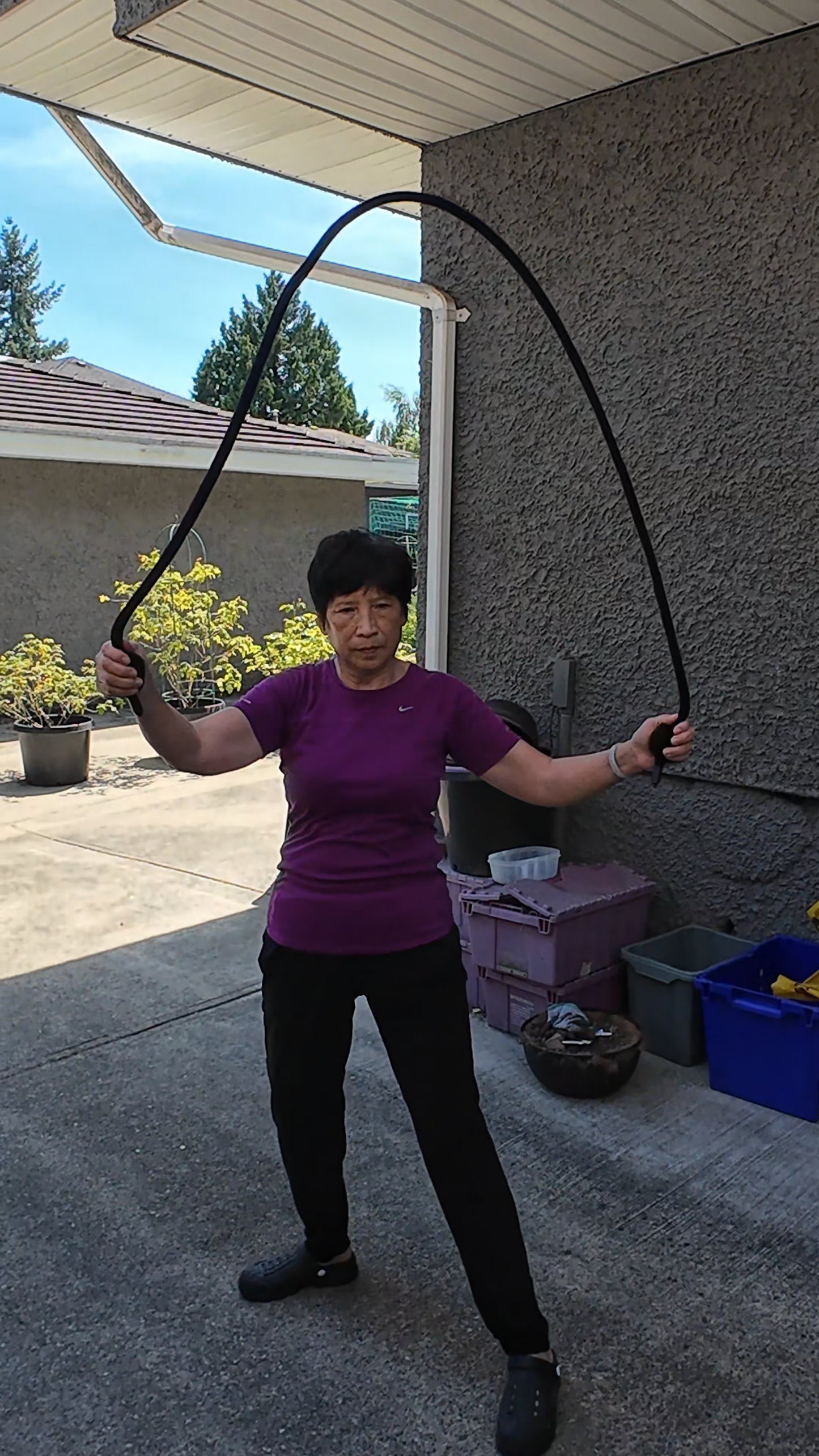
Rope Flow is a movement practice that involves swinging and guiding a rope through continuous patterns around your body.
Instead of simply repeating a lift or following a fixed path, you learn to coordinate your hands, arms, torso and lower body as the rope moves.
Different patterns challenge different combinations of timing, rhythm, coordination, balance and rotational movement.
Take the Figure-8, for example.
As the rope travels from side-to-side, your arms guide the pattern while your torso participates in the movement. You learn to coordinate the rope's momentum with your body's motion.
Start slowly, focus on the mechanics and gradually develop smoother transitions.
As you become more comfortable, explore different patterns, directions and footwork.
Because the rope provides physical feedback, you have something tangible to coordinate with rather than simply following a list of directions.
You're not just moving your body. You're learning to move it in relation to something else.
Rope Flow provides a way to practise coordinated, multidirectional movement while keeping the experience engaging.
Rope Flow vs. Traditional Strength Training
Do you need to choose between Rope Flow and lifting weights?
Absolutely not.
They serve different purposes and complement each other.
| Traditional strength training | Rope Flow |
|---|---|
| Builds strength | Practises continuous movement and coordination |
| Sets and repetitions | Flowing and linked movement patterns |
| Emphasizes specific muscles | Combines arm movement, timing, and whole-body coordination |
| Develops capacity to produce force | Improves controlling movement and momentum |
| Progressive loading | Progressed through technique, patterns, direction and complexity |
This isn't a strict division. Strength training can include rotation, balance and coordination, and Rope Flow can challenge muscular endurance too.
The point isn't that one is superior. It's that your training can include more than one way of developing physical ability.
Lift weights to build strength. Walk or run for cardiovascular fitness. Play sports for skill and competition. Explore mobility and rotational movement to practise moving in different ways.
Don't abandon what already works for you. Add to it.
Move Well, Not Just More
You don't have to be an athlete to benefit from moving in different ways.
You don't need to be incredibly strong, particularly flexible or naturally coordinated to begin.
Start with movements you can control. Build consistency. Gradually explore new patterns and challenges.
Keep doing the activities that help you build strength and fitness, too.
Being fit isn't only about how much weight you can lift, how fast you can run or how you look in the mirror.
It's about what you can do with your body when life happens.