Lower Back Pain From Sitting? Try This 3-Minute Rope Flow Reset
By Chin Chang, founder of TRG Flow Updated
Share
If you spend almost all day working at a desk and you're in your 30s, chances are you've experienced lower back pain from sitting.
Maybe it's a dull ache by the end of the workday.
Maybe your lower back feels stiff when you stand up.
Or maybe you've simply started accepting it as part of getting older.
Don't.
Getting older doesn't automatically mean you have to live with a stiff, achy back.
The modern desk job simply asks our bodies to do something they aren't particularly good at: Stay in one position for hours at a time.
And even if you have the perfect ergonomic setup, there's another piece of the puzzle that's easy to overlook.
You NEED to move.
Why Does Sitting All Day Cause Lower Back Pain?
Lower back pain is complicated. Sitting might not be the sole cause of your back pain.
But spending long periods without movement and physical activity is one of the causes. Staying active is an important part of maintaining back health and managing many forms of low back pain.
I know this firsthand.
I've spent hundreds of dollars trying to make my workstation more ergonomic.
- I bought a standing desk.
- A Herman Miller ergonomic chair.
- A laptop stand.
- A wireless keyboard and mouse.
I've tried to get my posture right.
And I still had back problems.
That's when I realized:
Good posture isn't the same as good movement.
You can have an incredibly ergonomic workstation and still spend eight hours barely moving.
You sit in your chair.
Then you stand at your standing desk.
Then you sit again.
You're changing your position, but you're still spending most of your workday moving within a very limited range.
Your spine isn't rotating much.
Your shoulders aren't moving through much range.
Your hips might change position, but that's about it.
For hours, you're essentially facing the same direction, looking at the same screen and reaching for the same keyboard and mouse.
Your body needs more variety than that.
The Solution Isn't Another Hour at the Gym
This is where things get interesting.
When people experience desk job back pain, the obvious solution is often to exercise more.
And exercise is important.
But if you're sitting for eight hours and then exercising for one hour, you still spent the other eight hours sitting.
What if instead of thinking only about your workout, you also thought about how often you move throughout your workday?
That's where movement breaks come in.
You don't need a full workout every time you get up from your desk.
Sometimes you just need a few minutes of movement.
That's What Got Me Into Rope Flow
I started using Rope Flow as a way to get more movement into my day.
Like a movement snack.
No need to change into gym clothes.
No need to drive to the gym.
No need to get sweaty.
You don't even need much space.
Just pick up a rope and start moving.
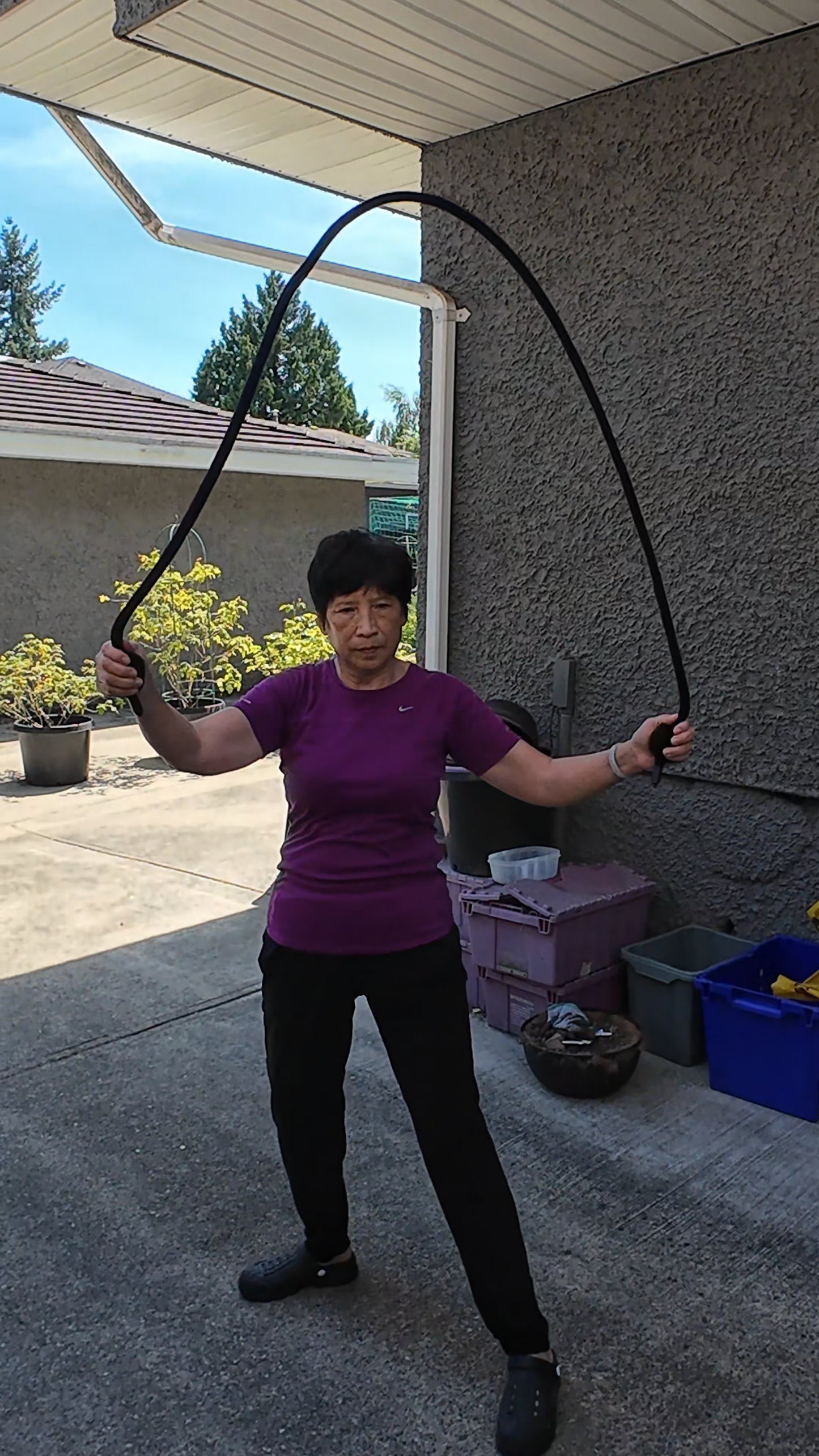
The rope gives you something to interact with while you move your arms, shoulders and torso through different patterns.
Unlike sitting at a desk, you're not just facing forward.
You're moving side to side, shifting your weight, rotating, coordinating your upper and lower body, and constantly changing positions.
Why Rotation Matters When You Sit All Day
One of the things that makes rope flow different from many traditional exercises is the amount of rotational movement involved.
Take the basic Figure-8 pattern.
Your arms move from side-to-side while your torso follows the movement.
Your shoulders and upper back participate.
Your weight shifts from one side to the other.
You're not just moving forward and backward or up and down.
You're twisting, tilting and rotating.
Now compare that to your typical desk setup.
Your monitor and keyboard is in front of you, your mouse beside you, your phone somewhere to the side.
For hours, almost everything happens within a relatively small area directly in front of your body.
Rope flow gives you an opportunity to move in a different way.
And that's the point.
Not to "fix" your posture.
Not to stretch your back into submission.
Not to replace strength training or cardiovascular exercise.
Simply to give your body some movement that it doesn't get while you're sitting at a desk.
Don't Wait Until Your Back Hurts
This is my biggest recommendation if you work at a desk:
Don't wait until your back hurts before you move.
Movement shouldn't just be something you do after you've become uncomfortable.
Instead, build small movement breaks into your workday.
Get up.
Walk around.
Stretch.
Do a few squats, bodyweight movements, or mobility exercises.
Or it might be three minutes of rope flow.
The specific activity matters less than creating a habit of moving more throughout the day.
Or pick up a rope and flow for a couple of minutes.
The goal isn't to exhaust yourself.
The goal is to break up long periods of sitting and give your body some movement variety.
Think of it as a reset rather than a workout.
Try This 3-Minute Rope Flow Reset
Here's a simple 3-minute rope flow routine for desk workers you can try after sitting for a long stretch. I recommend doing this every 20-30 minutes.
You don't need to go hard.
Keep the movements comfortable and controlled.
1. Underhand Figure 8 (1-min)
Start with a relaxed Underhand Figure-8.
Keep your grip loose and let the rope guide your movement.
Focus on allowing your shoulders and torso to participate rather than keeping your upper body rigid.
Don't worry about speed. Just find a comfortable rhythm and let your body move.
2. Matador Leg Lifts (1-min)
Next, add some gentle movement through your hips and legs with alternating Matador Leg Lifts.
This also gives you an opportunity to work on balance and coordination.
You don't need to lift your leg particularly high. Keep the movement comfortable and controlled.
The goal is simply to get your hips, legs and torso moving after they've been relatively stationary.
3. Dragon Rolls (1-min)
Finish with Dragon Rolls, alternating directions.
Keep things smooth rather than forcing a large range of motion.
Think of this as exploring movement rather than trying to stretch your back as far as possible.
That's it! 3 minutes.
Now get back to work!
The Best Exercise for Desk Job Back Pain Is One You'll Actually Do
There's no single exercise that will prevent or cure everyone's lower back pain.
And Rope Flow isn't a treatment for an underlying medical condition.
But if your workday involves sitting for hours, adding more movement to your routine is a simple place to start.
Don't wait until you're in pain.
You don't need another complicated workout program.
And you don't need to spend hundreds of dollars upgrading your desk setup.
Sometimes the simplest solution is to simply get up and move.
Move more. Move often. Move differently.
And if you've got a rope sitting beside your desk, that's one more reason to pick it up.
A Note About Lower Back Pain
If you have persistent, severe or worsening lower back pain, pain following an injury, numbness, weakness, or other concerning symptoms, speak with a qualified healthcare professional.
Rope Flow should feel like movement, not something you need to push through pain.